Applied Plant Synthetic Biology
Engineering plant chemistry
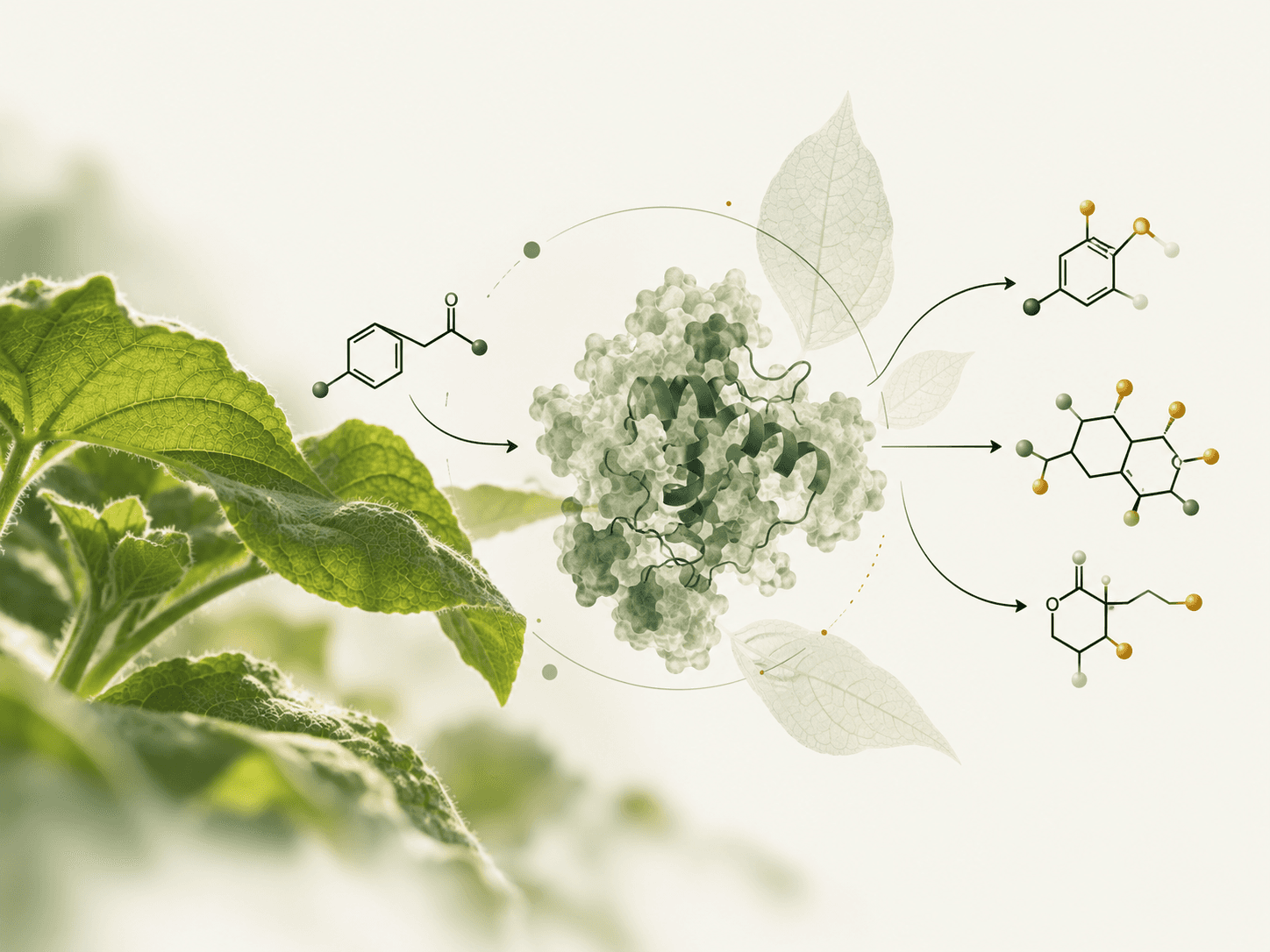
We investigate how plants make specialized molecules and use synthetic biology, enzyme discovery, and metabolic engineering to reconstruct and redesign their biosynthesis.
SEQUENCE → ENZYME → METABOLITE

ENZYME FUNCTION · PATHWAY ENGINEERING · PLANT METABOLISM
Biology makes extraordinary chemistry. We want to understand how—and learn how to redesign it.
Plants make an immense range of specialized molecules. The Kruse Lab combines molecular biology, biochemistry, genomics, metabolomics, enzyme discovery, and synthetic biology to understand the pathways behind this chemical diversity.
We connect genes to enzymes, enzymes to molecules, and molecules to experimentally and biotechnologically useful systems.
Research
A connected pipeline for understanding plant metabolism
DISCOVER → UNDERSTAND → ENGINEER
01 — Discover
Discovering the enzymes behind plant chemical diversity
Comparative genomics, transcriptomics, phylogenetics, protein analysis, biochemical assays, and metabolomics identify enzymes across specialized pathways.

02 — Understand
Understanding how pathways create chemical diversity
We study enzyme specificity, pathway organization, metabolic context, and structure–function relationships across plant evolution.

03 — Engineer
Rebuilding and redesigning plant metabolism
Synthetic biology and metabolic engineering rebuild pathways in Nicotiana benthamiana, yeast, crop plants, and other heterologous systems.
Selected research areas
Pathway engineering
Engineering complex plant specialized metabolism
We investigate how enzyme properties, precursor supply, pathway architecture, and host context shape the performance of reconstructed plant metabolic pathways, using montbretin A and other systems as experimental models.
Enzyme discovery
Discovering unusual plant alkane metabolism
Investigate the molecular basis of unusual short-chain alkane production in selected pine species using comparative transcriptomics, biochemistry, and synthetic biology.
Sequence–function
From protein sequence to biochemical function
We use phylogenomics, experimental sequence–function datasets, and computational modeling to identify the sequence features that determine enzyme specificity and activity.
Volatile metabolism
Understanding the enzymes that create plant volatile diversity
Investigate enzymes involved in volatile specialized metabolites and aroma formation, including acyltransferase-mediated ester biosynthesis.
Scientific community
PhytochemTalks
An international online seminar series in plant specialized metabolism, co-founded by Lars Kruse, Gaurav Moghe, and Lucas Busta.
